Monday, 17 October 2011
BACK TO WHERE WE STARTED
After a fabulous time in Ibiza and London, we are now back in Trinidad to rescue Irony from her storage and get her back in the water. For further news and pictures visit www.IronyLondon.com


Sunday, 21 August 2011
THE FINAL CHAPTER

We were unable to get on a ferry to our next stop, Moorea. We discovered we were travelling on a holiday weekend and everything was chock-a-block. In the end we flew Air Tahiti which was a quick half hour hop with wonderful aerial views over the islands.

Only in Moorea for 24 hours, we rented a car and toured the island. First we had to find somewhere to spend the night and our hearts sank when we stopped at the first 3 or 4 pensions and hotels to find them fully booked. Luck was with us when we found space at Fare Maorina in Haapiti. A rainy afternoon curtailed our sightseeing on Monday but we enjoyed listening to some live jazz that evening at a restaurant on beach. The sun was shining on Tuesday and we were able to see the breathtaking views from Belvedere of deep bays and dramatic mountain ranges.
 A fast catamaran took us across to Tahiti where checked into Pension at Punaauia. It was quite a contrast to be on such a populous, busy island. We went souvenir hunting in Papeete – a difficult task as everything is so expensive – and managed to find some goodies for the family and a few things for ourselves. I am now the proud owner of a stunning necklace of black Tahitian pearls (an early birthday present!).
 We hired a car again and embarked on another round the island tour. Not impressed by the limited views from the coastline road I suggested taking a cross island route through the Papeno’o Valley. It took us through breathtaking scenery of high mountains running with a multitude of waterfalls, rich vegetation, river fords and no sign of habitation. As we progressed to the centre of the island, the road deteriorated and our little Peugeot was struggling with the rough terrain. We pressed on, ignoring signs warning against the road being only suitable for 4 wheel drive vehicles, feeling we were now too far along to turn back. Somehow we made it to the other end but it took all day and was slow progress as we had to construct ramps of stones to enable the car to make it over some of the ridges and ditches; at one point we had to jack it up to move forward.
 The whole experience was made more stressful because we were due to return the car at the airport that evening and fly to London! It was dark by the time we reached the south of the island and we found a chain across the road and a local family was demanding 2,000 Polynesian Francs (about 16 Euros) for us to pass. Apparently the road crossed private land at this point but there was no warning sign for anyone approaching from our direction. We pleaded with the family for sympathy to our plight but they wouldn’t relent and we had to pay.

Somewhat exhausted we boarded our Air Tahiti Nui flight to Los Angeles where we enjoyed a great lunch at the wacky Encounter Restaurant at LAX. Then we flew on to London with Air New Zealand having covered about 9000 miles. We are now adjusting to the 10 hour time difference but enjoying a warm and happy reunion with the family. We will return to Irony in Trinidad at the beginning of October after spending September in Ibiza.
Future news and pictures will be posted on our usual blog site: http://www.sailblogs.com/member/irony/
Tuesday, 9 August 2011
HOP TO HUAHINE
We were unsuccessful getting a ship to Huahine on Thursday; the Taporo was full and we had to get the Hawaiki Nui the next day. We spent our extra night on Bora Bora at Chez Robert & Tina, a pension on the very southern tip of Matira Point with panoramic views from our balcony of the lagoon.

 The Hawaiki Nui was a fascinating experience although rather slow, taking a day to reach Huahine about 60 miles away. The quayside at 7am was bustling with passengers and people ready to pick up their incoming produce and supplies. When the ship docked we watched the seamless operation of unloading containers and palettes by a multitude of small forklift trucks racing in all directions with no obvious supervision and certainly none of the worry about safety that one would see in Europe. At 11:30, once the ship had re-loaded, we joined the other passengers on the top deck where most of the locals set up camp in a central area on mats and blankets with their picnics. The views leaving Bora Bora were spectacular and it was interesting to see both Tahaa and Raiatea on our next two stops.

 We rented a car for a day and toured the island. Lush, mountainous Huahine takes its name from hua (phallus) and vahine (woman). Made up of 2 islands joined by a bridge over a narrow pass, the population is almost entirely Polynesian and tourism is very low key. Along the way we spotted ripe mangoes along the road and collected dozens, a lucky find as fruit is not cheap to buy. We also provisioned for the week in the fairly large supermarket in Fare. Food is expensive but the self-catering option is far more economical than eating out. It is hard to find a restaurant serving main courses for under 20 euros.
 Human habitation on the island dates back 1300 years and a number of marae (chief’s encampment) have been found and restored here, easily seen at Maeva. They are made up of stepped coral stone platforms that served as raised seats for the gods; there are also ancient stone fish traps in the river. We stopped in Faie and saw the sacred blue-eyed river eels which congregate under the bridge; legend credits them for bringing fresh water to the village. They were surprisingly large, very similar to morays, and plentiful.

On one of our journeys to the quay on the local transport (a kind of open truck with seats in the back) Nic struck up a conversation with a French economist and found out some interesting information about how French Polynesia works. Apparently 60% of the population are unemployed but everyone receives a “salary” (guilt payment for the decades of nuclear testing) and is able to live extremely well. We have been impressed by the quality of the houses here (not the shacks seen in the Caribbean) the multitude of impressive private gardens (not usually evident in the third world), the number of new vehicles on the remotest, tiniest islands and the prevalence of toys such as outrigger canoes. It would seem the French population is largely unaware of how much money is paid in subsidies to this area. Additionally, French civil servants receive 3 times their normal salaries in “hardship” pay to come and work here; needless to say it’s a popular posting. Sadly the whole set up makes these island incredibly expensive to visit (especially in comparison to somewhere like Thailand) and the economist said that Polynesian culture in the process of being destroyed as no one feels the need to work anymore.
 The Hawaiki Nui was a fascinating experience although rather slow, taking a day to reach Huahine about 60 miles away. The quayside at 7am was bustling with passengers and people ready to pick up their incoming produce and supplies. When the ship docked we watched the seamless operation of unloading containers and palettes by a multitude of small forklift trucks racing in all directions with no obvious supervision and certainly none of the worry about safety that one would see in Europe. At 11:30, once the ship had re-loaded, we joined the other passengers on the top deck where most of the locals set up camp in a central area on mats and blankets with their picnics. The views leaving Bora Bora were spectacular and it was interesting to see both Tahaa and Raiatea on our next two stops.

It was after sunset when we arrived at the small quayside of Fare on Huahine. We managed to hitchhike to our pension, Chez Henriette, and were lucky to have a patient driver because it was very difficult to find in the dark. We had our own little fare with a kitchen, basic but clean and sweetly decorated with lots of coloured materials. The next day we hired a car and moved to Pension Te Nahe Toe Toe in Parea, further south. We are now installed in a gorgeous thatched bungalow overlooking the beach and will stay here until we island hop to Moorea on Friday. There are communal cooking facilities in the garden and we have free use of kayaks and bicycles.

 Human habitation on the island dates back 1300 years and a number of marae (chief’s encampment) have been found and restored here, easily seen at Maeva. They are made up of stepped coral stone platforms that served as raised seats for the gods; there are also ancient stone fish traps in the river. We stopped in Faie and saw the sacred blue-eyed river eels which congregate under the bridge; legend credits them for bringing fresh water to the village. They were surprisingly large, very similar to morays, and plentiful.
So we are happily settling into island life, facing the difficult choice of how to amuse ourselves each day in paradise and feeling very privileged to be here.
Thursday, 4 August 2011
AND ON TO THE SOCIETY ISLANDS

An overnight sail took us across to the next and largest archipelago of French Polynesia, the Society Islands which include Tahiti. We arrived in Bora Bora, the pearl of the South Seas, on 1st August and sailed through the Te Ava Nui pass marvelling at the luminously turquoise waters of the island’s famous lagoon which even gave a remarkable blue hue to the clouds above. The spectacular colours and dramatic scenery here are a testament to Bora Bora’s popularity.
Our first stop was at Vaitape, the main “town”, not the heaving tourist centre we expected although much busier than anything we have seen in the Marquesas or Tuamotus. We anchored for the night off Toopua Motu in what can only be described as “cruisers’ corner” but a gorgeous spot with a view of the striking Otemanu summit and perfectly situated to watch sunset across the reef.
 On Wednesday we departed Spiip and will spend the next couple of weeks island hopping down to Tahiti. We couldn’t have been more fortunate with our first pension, Chez Nono on beautiful Matira beach. We have a lovely thatched hut built out over the water, incredibly romantic and the perfect place to celebrate our 14th wedding anniversary. Our champagne lunch of a delicious baguette, cheeses and salamis overlooking the white sand beach will be one to remember
 Today we rented bicycles and made the 32km circuit of the island. The road is pretty flat and well-paved and winds its way around the jagged shoreline. Once again we were impressed with the effort the Polynesians put into their beautiful gardens; they have a wonderful sense of the aesthetic. Flowers are everywhere and even the woman at the check out in little supermarket in town was wearing a fresh flower wreath in her hair.
Tomorrow we are hoping to take the cargo ship, Taporo, to a neighbouring Huahine. Somewhat different to a super yacht but it should be fun as it’s the local mode of transport between islands. It’s not possible to buy a ticket in advance so we have to be there when it arrives to secure one of the 12 places available for passengers.
Saturday, 30 July 2011
SNORKELLING WITH WHALES!
 From Kuehi we sailed to Fakarava, 32 miles x 15 miles, it is the 2nd largest atoll in the Tuamotus. It was visited in the 19th Century by Matisse and Robert Louis Stevenson. Just before we entered the southern pass we spotted some humpback whales and slowed down to watch one breach right next to the boat. Sadly we were too late getting our cameras out to capture the moment.
 We anchored in the south in shallow turquoise water littered with bommies for a couple of days, enjoying some great snorkels along the pass. We’re getting very used to swimming with sharks now. On our way north we stopped along the way at an exquisite beach spot. It was a true tropical paradise, no habitation just white sand, coconut trees and crystal clear water. Anchoring off the village in the north, we managed to buy a few vegetables from someone’s little market garden; provisioning is definitely a challenge in this archipelago.
 En route to the next atoll of Toau, Robin spotted some whales by the boat. Calm conditions made it possible to stop and jump in the water to snorkel with them, an incredible experience. They were a pair of minke whales, about 30ft in size, and the longer we spent in the water with them the more comfortable they became and the closer they came. What a fantastic once-in-a-lifetime opportunity! They were particularly interested in Spiip and swam up, under and through the rudders and around the keel.

Friday, 22 July 2011
ON TO THE TUAMOTUS
 Often called the “Dangerous Archipelago”, the Tuamotus are made up of 78 coral atolls extending almost 1000 miles and known for their variable currents, sudden storms and reefs littered with wrecks. 16,000 people live on 48 of the islands and make a living from copra and black pearls, now only cultured. The area is famous for the nuclear testing France carried out on Mururoa and Fangatauta from 1966 to 1996 during which time 181 nuclear bombs were exploded in the atmosphere and underground. It was a shocking disregard for the pristine environment and local people; the cause of long term and continuing environmental and health problems here.

Spiip sped along on our passage from the Marquesas and we arrived off Kauehi in the dark on Saturday morning and hove to until daylight.
We headed through the Arikitamiro pass bordered by low wooded bands of coral and into the lagoon. Of about 6000 km2 of protected lagoons in the Tuamotus, only 726 km2 is actually land and we could barely see the other side of the atoll 7 miles away. The sun was still too low to make our way safely over to the village so we dropped anchor in 26m of water and decided to snorkel by the pass.

As we each plunged into the water off the dinghy we all let out exclamations of delight at the crystal clear water, colourful coral and multitude of fish. It was without doubt the best snorkelling any of us have seen since the Red Sea. We were struck by the size of the fish – huge groupers everywhere, several Napoleon fish, giant morays, schools of enormous parrot fish; it was like a spectacular aquarium. There were also dozens of sharks of at least 4 different species swimming all around us but fortunately none over 2 metres and for the most part they seemed very uninterested in us.
In the afternoon we anchored by the little village of Tearavero marvelling at the spectacular colours of turquoise water punctuated by ramshackle wooden stilt houses, white sand and green coconut trees. We walked across the narrow spit of land to the windward side to beachcomb, picking up beautiful pieces of coral and cowry shells. The next day we returned to anchor near the pass for the night so that we could enjoy some more snorkelling there before setting off for Fakarava on Sunday morning.
Wednesday, 20 July 2011
ABAI TO THE MARQUESAS

We moved from Taiohae to Anoha Bay on the north of the island to avoid an increasing swell which would make the town’s anchorage untenable. Once again we were overwhelmed with the spectacular natural beauty of our surroundings. On arrival we jumped in to snorkel on the nearby reef and were disappointed to find the water was full of plankton (good for manta rays but bad for visibility). As I reached the shallow coral I looked down to see a reef shark dart underneath me from behind. I continued on but couldn’t clear my mind of the shark feeding frenzy I had seen off the quay in Taoihae, capitulated and swam back to Spiip.


On Tuesday night we prepared to start our 550 mile passage to the next island chain. We were ready and relaxed as we started to store the dinghy in the tender locker but that mood quickly changed as it sprang off its prong on the end of the boom and started flying about wildly, crashing along the hull. Before we got it under control it had bent a stainless steel stanchion on one swing and the outboard had taken a chunk out of the side of the boat near a porthole (lucky it didn’t hit the glass)on another. The aluminium was dented on one of the dinghy’s pontoons, an engine winglet was dislocated and the propeller irrevocably damaged. More repairs for poor Robin to tackle.
After dinner we set off from the dead calm of Anoha Bay and found ourselves suddenly in 4 to 5 metre waves and a howling 30 knots of wind. We had an uncomfortable time rounding the island until we could get on to a more favourable course. Somewhere in the midst of all this, the cups for the wind indicator came off the top of the mast and we were left with only direction, no true or apparent wind speed. Boats!
Friday, 15 July 2011
14th JULY CELEBRATIONS

Bastille Day happens to coincide with a much earlier pagan festival to mark the Southern Hemisphere solstice and culminates a 2 week event called Heiva. The day of celebrations began in the morning with a parade of costumed dancers and decorated floats followed by horse races along the beach. Dressed in grass skirts, adorned with traditional tattoos and painted faces, the riders were a daunting spectacle. It was not only the participants who dressed up for the occasion; most of the women were decked out with intricate headdresses of fresh flowers which they have specially made up and, if cared for, can last a fortnight.
 The festivities were compeered by one of the many ladyboys here. Apparently if families have too many male kids, the last born will be brought up as a girl. It is obviously quite a common practice because we have seen a number of incredibly effeminate men around. They are a totally accepted and normal part of the community.

We tucked into a delicious spread of quiches, open sandwiches and cakes, all compliments of the town, before watching a dance display and singing by a school group from Tahiti who are visiting the island for the summer. In the afternoon we sought out the source of some great drumming we heard and ended up watching a rehearsal for a competition. We were memorised by the energetic show put on by the dancers and the harmonious sound made by a variety of local drums and are sad to be missing the full costumed display which will take place on Saturday night. Getting in the dinghy we watched dozens of kids swimming just next to quay where we saw all the sharks being fed...population control?!

Returning to town for dinner we chose one of 3 indoor/outdoor eateries arranged around an open space adjacent to the town’s communal hall. We were treated to a fantastic traditional dance display by different groups and a stunning performance by a fire dancer, all part of the celebrations. It was the classic Polynesian swaying hips in grass skirts with garlands of sweet smelling flowers around their necks and in their hair. The ladyboy compeer entertained the crowd with karaoke in between acts!
Wednesday, 13 July 2011
NUKU HIVA


We are now in Tahoiae, the administrative centre of the Marquesas and hoping to join in the Bastille Day celebrations here tomorrow. The cathedral here, built in the 70’s, lovely. Beautifully designed, it is graced with some stunning wood carvings of the stations of the cross and a pulpit cleverly carved out of a huge trunk by local sculptors. The town quay is also an entertaining spot where the fishermen cut up their fish throwing the bones and scraps in the water to the waiting, circling sharks. Swimming is definitely not appealing in this bay!
MORE OF THE MARQUESAS
 Our stop in Hiva Oa was very brief. The anchorage at Tahauku Bay was full of boats and it was a challenge to find room for Spiip, necessitating a stern anchor to keep us off the neighbouring yachts. Once we had completed the check in at the gendarmerie in Atuona and had a quick internet hit to download the last 2 weeks of emails, we sailed off to Tahuata, 9 miles away. It was after sunset when we anchored in Hanamoenoa Bay.

Other than enjoying some good snorkelling, we have been working hard on cleaning the boat and Spiip’s hull, after several washes (the luxury of a water maker), is now gleaming.
Back on Hiva Oa, we visited Hanaiapa Bay, another dramatically stunning anchorage. We walked up the picturesque village road bordered by verdant and well kept gardens of fruit trees and exotic flowers. With each stop we are overwhelmed by the warmth and generosity of the locals. We were invited in to their houses for coffee and cold drinks and left laden with huge stems of bananas, melon-sized grapefruit, mangoes and breadfruit, even bunches of freshly picked watercress and basil. No one will take any money for the fruit; it seems to be the norm that you just give something in exchange.
 At William’s “Yacht Club” we were also given a lesson in the Marquesan language and now can use a few words of greeting and thanks instead of our rusty French. Robin was surprised to find quite a few similarities with Maori in New Zealand. Unfortunately Tahiti has a difference language so we will have to start learning again soon. Unusually, William spoke good English and for the last 30 years has been welcoming yachts to Hanaiapa. We signed his latest book while he told us that he sadly lost most of the previous years’ books to a fire.
From Hiva Oa we sailed up to Ua Hika but were unable to stop because of the huge swell running into all the anchorages. We reached Ua Pou by sunset and anchored in Baie d’Hakahaetau. On Sunday morning we visited the village, another picture postcard place. Uao Pou is distinctive for its pillars of volcanic rock that create a magnificent skyline. It also has a unique rock that is only found there and used for carving tikis. We had a lovely walk past an archaeological site which gave an idea of how the early communities lived on the islands before they were decimated by the Europeans and Americans.
 In the afternoon we set sail for Nuku Hiva. On the way we caught a 30 kg yellow fin tuna. As Robin was reeling it in we realised it was being chased by a good sized shark. (One really doesn’t want to fall overboard around here!) Before Nic gaffed the tuna the shark had taken a good chunk out of its tail. Miranda has been working hard over the last couple of days to process all the meat and preserve it in oil, resulting in 19 large jars.
Monday, 4 July 2011
FIRST IMPRESSIONS

 The Marquesas, although inhabited by the Micronesian people who populated Hawaii and Easter Island from about the 1st Century AD, were first “discovered” by the Spanish in 1595. On arriving in Fatu Hiva, Alvaro Mendaña, was greeted by the tattooed natives paddling out in their canoes in welcome. He responded by massacring over 200 of them and leaving syphilis as their legacy. Over the following centuries the islands’ population was further decimated by disease dropping from 80,000 (early 1800s) to 2,000 in 1926.
 After 2 weeks at sea we really feel we have finally reached a completely new part of the world. Very different from the Caribbean, there is a distinctive “South Seas” feel to the place; it is the archetypal tropical paradise. The Marquesas are the most isolated part of French Polynesia and we found that much of the economy still functions through bartering and exchange. A fishing lure or some good rope can have more value than euros here. The picturesque village, bordering the river, is pristine and all the houses abound with fruit trees and flowers. We now have about 25 kilos of enormous grapefruits and, after someone shinnied up a tree to pick them, a sack full of oranges. We also collected leaves from the extremely fragrant lemon trees to make tea.
 The people are incredibly open and friendly and gave us a warm welcome. Wood, stone and bone carving seems to be the major occupation and we visited several sculptors to look at their work. Robin and Miranda bought a stunning tiki carved of rosewood. We were tempted but they are too large and heavy for our hand luggage! Sunday morning we attended the Roman Catholic church service which was conducted in the native Marquesan language. The singing was fantastic and their lovely harmonies filled the building.
We managed to go on a couple of walks to get our atrophied muscles moving after our long passage. The island is breathtakingly beautiful, very lush and green with dramatic mountains and steep roads and tracks. Following a path strewn with blossoms, we visited a waterfall and had a refreshing dip in the cool waters at its base.
It has been a wonderful stop before sailing across this morning to larger Hiva Oa to officially check in.
Sunday, 3 July 2011
Arrived in the Marquesas
After 14 days at sea we have arrived in Fatu Hiva, the most southerly of the Marquesas. We really feel we have landed in the ubiquitous tropical paradise. It's a spectacular anchorage and the people here are welcoming and friendly. We made excellent time on our passage, sailing about 3085 miles in 13 ½ days. We will probably head to Hiva Oa on Monday morning so we can do the official check in. Stories and pictures when we find some internet!
Sunday, 26 June 2011
Smooth Passage
We've passed the halfway stage having covered over 1500 miles in 7 days. Today we sailed 247 miles. Days are spent reading, eating, sleeping and on watch with the occasional excitement of catching a fish - 2 mahi mahi yesterday.
Saturday, 18 June 2011
GALLOPING THROUGH THE GALAPAGOS ISLANDS
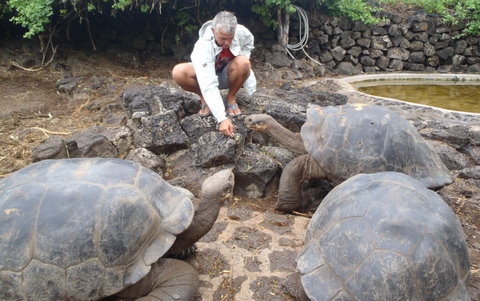

The islands are of course famous for their unique wildlife and whatever I write here is going to sound like a cliché. What we first noticed is how unafraid of humans the birds and animals are. It’s very special to get so close and, of course, makes for some amazing photo opportunities. We have been feeling like extras in Dr Doolitle or Disney's Snow White!
Within a short walk of the town, Punta Ayora, is the Darwin Institute, an active research and conservation organisation with a breeding centre for giant tortoises and land iguanas from the islands. The iguanas suffered from introduced species such as dogs. Tortoises were decimated over preceding centuries by pirates and mariners who collected them as live meat for their long passages. It’s heart-wrenching to think of these gentle creatures, which can live for up to 200 years, being treated so hideously. Heavy rain deterred “Lonesome George” from being very visible. He is the only one left from his particular type and proving reluctant to breed with tortoises from other islands. We spent a lot of time watching the antics of the youngsters in their enclosure; climbing over each other, getting turned upside down and practising some male rivalry.

Another walk took us to Tortuga Bay, a long, powdery white sand beach where we encountered hundreds of black marine iguanas snoozing in the sun. They are incredibly well camouflaged in the black volcanic rocks along the shore line, so much so that initially we walked straight past them. A spectacular grove of opuntia cactus trees, which grow out of the tuff, separated the beach from an inland lagoon.
 We were enchanted by a blue booby who was happy for us to get very close. They look like cartoon birds with their bright blue feet, almost like they have been fitted with silicon gum boots. IN the evening, we saw small sharks in the shallows of the surf possibly lying in wait for the baby turtles who, once hatched, make their way into the sea from the dunes behind.
 We were enchanted by a blue booby who was happy for us to get very close. They look like cartoon birds with their bright blue feet, almost like they have been fitted with silicon gum boots. IN the evening, we saw small sharks in the shallows of the surf possibly lying in wait for the baby turtles who, once hatched, make their way into the sea from the dunes behind.
 The fish market in town is probably the best entertainment in Santa Cruz. Dozens of pelicans hang out for tidbits of fish but pay deference to the sea lions that nestle up to the legs of the fishermen waiting for the scraps. Hours could be spend watching this scene.
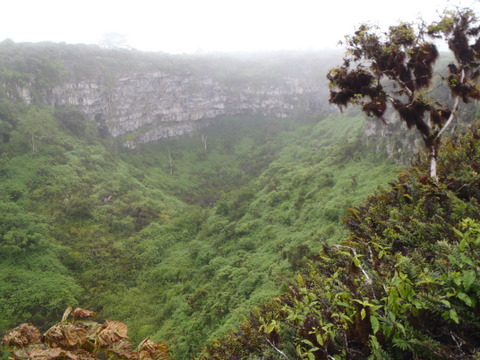 We headed inland with a taxi for a few hours to see some volcanic craters and walked through a giant lava tunnel carved out about 5 million years ago by a river of boiling rock. Our driver was actually from Cuba, married to an Ecuadorian, and proved very interesting.
Expecting over-inflated prices, we have been pleasantly surprised. Prices aren’t third world but we haven’t felt “fleeced”. There’s a great street of food stalls with tables and chairs down the middle where you can find delicious meals for around $6 with a lively atmosphere and good service. There are also some fantastic galleries and shops selling more than the average tourist tat. It's refreshing, after Panama, to be somewhere with no real crime problem. Oh yes, and there's no rubbish!
Four days are a woefully short time to spend here but it has been fantastic. Maybe we will be able to visit more islands in the archipelago when we return here with our own boat. In the morning we set sail for the Islas Marquesas, the first stop in French Polynesia. We have about 3000 miles ahead of us but, with good winds, Spiip should cover that distance in less than 3 weeks.
Wednesday, 15 June 2011
LAS PERLAS TO THE GALAPAGOS
Our stay in Contadora was brief. We arrived in the evening, anchoring in Galeon Bay but the next morning were asked to move on as our mast was causing interference for the small planes landing at the tiny airstrip behind the beach. We weren’t sorry to head off to Isla Casaya, 11 miles away, as there was too much rubbish floating in the water to warrant a swim. On exploring around the headland we also saw a pipe taking “effluent” out into the bay, not very appealing! The beach there, lined with the derelict remains of more than one fairly substantial resort hotel and an abandoned ferry, had a spooky atmosphere and we wondered what had caused its demise.


We explored by dinghy, visiting a gorgeous beach, where we finally swam in turquoise clear water, and pressing our way up a narrow, mangrove-lined river. All our repair problems seemed far away, for a moment or two. Our run of bad luck with a multitude of things breaking or ceasing to work continued with the wind instrument giving up the ghost through corroded contacts. The challenge was met and it was repaired with a sewing needle!
Our final stop was at Punta Cocos on the southernmost tip of Isla Del Rey. Very rolly, we anchored the dinghy off the beach and swam in to be met by a couple of policemen. Our worries that we were going to be asked for papers (we were already checked out in Panama City) were quickly dispelled by a friendly welcome and concern about the dinghy which they thought was floating freely. We walked to the old WWII airfield and a beach on the other side. The spectacular views were spoiled by the lovely sand littered with plastic, the scourge of our times.

The next morning we set off early for the Galapagos, relieved to be departing “Spanama”, so named for our run of bad luck. As if to herald the abundant wildlife we are expecting to see there, we saw a passing sea snake, turtles and a multitude of dolphins including one massive pod of at least 100. For quite some time after leaving the mainland we had the ubiquitous plastic floating past and a good selection of enormous logs which made useful rafts for the seabirds. At night we were surprised to have a group of seagulls swooping and soaring around the sails and navigation lights. They seemed to prefer green light to red but, if they were using it to fish, they were rarely seen to dive into the water. During the day our sentinels were happy with some squid thrown up to them that had landed on deck.
We hooked a tuna on day one and were left with only its head after a shark decided to have it for dinner. Robin also caught what looked like a 6’ marlin but it freed itself before it was reeled in.


Subscribe to:
Posts (Atom)